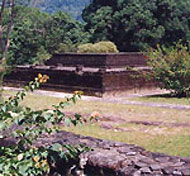
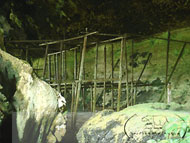
The reconstruction of the candi found at the premise of the lembah bujang museum |
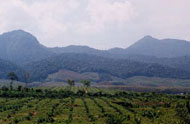
Bujang Valley stretches all the way from Gunung Jerai in the North to Sungai Muda in the South. The area concentrated around the mouth of Sungai(River) Muda has been of economic importance to Kedah since as early as the 5th Century AD. Buddhist inscriptions found in the valley were proof that the Indian traders were already making frequent visits to the area during these early periods. However 2 centuries before, Malay mariners were already making long-distance voyages across the Bay of Bengal, trading rainforest produce in return for metals, textiles and other rarities much sought after in their homelands as status symbols. By the 7th century, trade with the Indians, Arabs and Chinese merchants in the Straits of Melaka had increased tremendously and the Bujang Valley evolved into an entrepôt. The early mariners were totally reliant on the monsoon seasons, which also was dictated by the wind patterns. Therefore, it was impossible to make a voyage from China to India in one season. The traders had to wait out for the wind change in safe harbours such as at Bujang Valley.
 |
With the influx of foreigners and locals alike, places of worship mushroomed - located up in the higher grounds. Kedah's cultural development during this era was strongly influenced by the people from various cultural origins namely a mixture of Indian, Sri Vijayan and Khmer. The valley became an archaeological paradise after the discovery of the candi in the area in the 1840's. Candi came from the word "Chandika' - the name of Lord Siva's wife. She was also known as Durga - the deity of death. The candi, in retrospect has two functions. One; it is a sacred place to pay respect to the deceased members of the royal families. Two;it is a place to conduct religious activities. The candi structure can be divided into 3 sections.
Upapitha |
The foot of the candi |
Adhistana-Stamba |
The body of the candi |
Prastara-Stupi |
The roof of the candi |
 |
 |
Drawings of structures excavated from the site |
|
Evidence indicates that the candi (pronounced 'chandi') can be divided into the Buddhist phase from the 5th to the 10th century; and the Hindu phase from the 10th to the 13th or 14th century. The Hindu structures consist of the vimana (enclosed sanctuary) where the main icon was kept; and a mandapa (open sided hall) with a roof supported on wooden pillars. The base was built with bricks, laterite or granite. A number of the candi designs found at the Lembah Bujang Archaeological Park are noted to be of Hindu influence whilst a few are of Buddhist influence. The various stone pillar bases found at several candi designs suggest architectural influences from South India especially temples dedicated to the worship of Lord Siva. The presence of the drain (snana-droni) to collect the water used to bathe the statuette of the deity and a spout (jaladwara) on the outside of the vimana where the water can be collected by worshippers, are common additions in temples in India but extremely rare here.
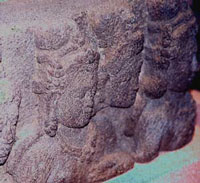 |
Hindu images have been excavated at the various candi sites such as the Ganesha (the elephant faced deity) and the Durga (the consort of Siva) and a bronze image of Lord Vishnu. Buddhist images were also found during excavation at sites nearby. In 1976, 4 terracotta Buddhist images and one made of bronze were found at sites 21/22 but the damaged condition makes dating difficult.
Lembah Bujang has a deep history that goes back 1500years . The rich archaeological finds have at least sealed an important part of Malaysia's history - the evidence that Malaysia and South East Asia had already entered the international arena of economics and ergonomics a long, long time ago.

Part of an old drainage system for the shrine. Water from the altar was drained into a container through a spout at the exterior wall where devotees collected and kept in pots as holy water for cleansing. |
However, as a visitor to an archaeological site so important, we couldn't help feeling something amiss whilst strolling in the museum grounds where the candi were located. Having to excavate all the sites scattered around the valley and grouping them in one area was perhaps rather more effective. Then the structures could be kept under the watchful eye of the authorities. That's fine. What we didn't get to feel was the soul of these ancient shrines. Perhaps it would have made the trip worthwhile if several of the sites could have been left in its state before being fully excavated. Like the photos displayed in the museum of the various stages of excavation. It would have certainly left a stronger impact on us….
Dated: 24th February 2001
Click here for History of Malaya
Peninsula Malaysia Historical Sites |
|
Negri Sembilan |
| Astana Sri Menanti (Palace) | Istana Ampang Tinggi (Royal Dwelling) | Kota Lukut (Fort) | Pengkalan Kempas (Archeaology) | |
Selangor |
| Bukit Melawati (Fort) | Jugra (Royal Dwelling) | Batu Caves | |
Terengganu |
|
Kuala Lumpur |
| Colonial Kuala Lumpur (Architecture) | Kuala Lumpur Old Chinatown | |
Perak |
| Gua Tambun (Anthropology) | Kellies Castle (Architecture) | |
Kelantan |
|
Kedah |
|
Melaka |
|
Sabah & Sarawak ~ Borneo Historical Sites |
|
Sarawak |
| Niah Caves | |
 More on Lembah Bujang (Bujang Valley)...
 Getting There and Away
 Best Time to Go